.png)
This is general, sourced information, not legal advice. Coverage, deductibles, and claim outcomes vary by policy and insurer, so confirm specifics with your own carrier, the Colorado Division of Insurance, or an attorney before making a decision.
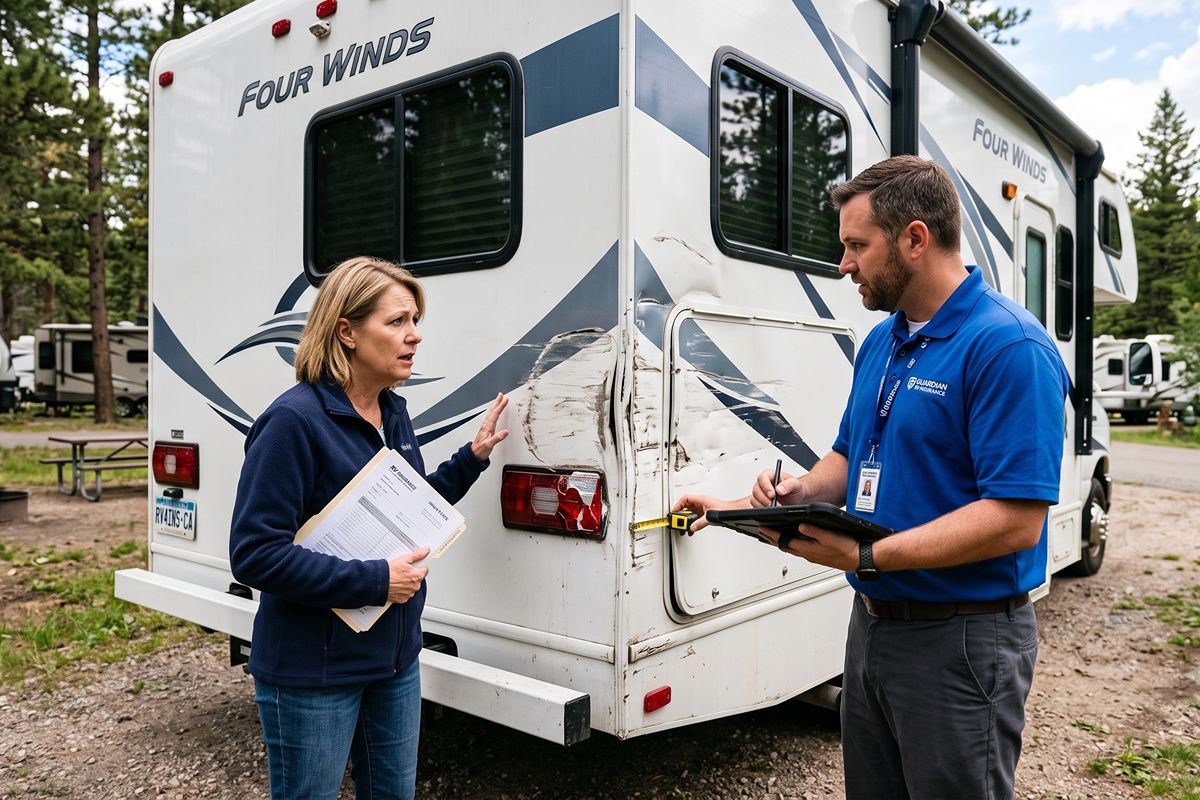
Colorado's Front Range sits in the middle of Hail Alley, so most RV owners here will face a hail or collision claim sooner or later. The process is not complicated once you know the order of operations: report the loss, document the damage, get an estimate from a qualified shop, and work the claim through to settlement.
Colorado also gives policyholders real, citable rights along the way, including the right to pick your own repair shop rather than whatever the insurer prefers. We handle RV insurance claims directly with adjusters every week at our RV body shop in Denver, so this guide walks through what actually happens between the storm and the final check.
Comprehensive coverage is the part of an RV policy that pays for hail, along with theft, vandalism, fire, glass breakage, falling objects, flooding, and animal strikes. Collision coverage is a separate line that pays for crashes, rollovers, and hitting another vehicle or object, regardless of who caused it.
Comprehensive is technically optional in Colorado, but almost every insurer includes it on an RV policy and the industry strongly recommends it in a hail-prone state like this one.
A car policy is built around getting you back on the road. An RV policy has to cover a vehicle that is also, in many cases, a second home, so RV-specific carriers add coverages a standard auto policy does not carry.
Common additions include agreed value or total-loss replacement (discussed below), full-timer coverage for owners who live in the rig full time, vacation and emergency expense reimbursement, personal effects coverage, and protection for attached accessories like awnings, satellite equipment, and slide-outs. Not every policy includes every option, so it is worth reading your declarations page or asking your agent directly which of these apply to your rig.
How your RV is valued on a total loss can swing the payout by tens of thousands of dollars, and most owners never look at this until the claim is already in motion. Here is how the main valuation methods differ.
Not necessarily, and this is one of the most misunderstood parts of an RV hail claim. Colorado law (C.R.S. 42-6-102) defines a salvage vehicle using a strict threshold: repair cost exceeding the vehicle's retail fair market value immediately before the damage. That is one of the toughest salvage thresholds in the country.
The important nuance is that Colorado's salvage-title definition specifically excludes damage caused by hail or theft. That means an insurer can declare your RV a total loss for settlement purposes, based on its own total-loss methodology, without the state branding the title as salvage. Total loss and salvage title are two different questions, and it is worth confirming which one applies to your situation with your insurer or the Colorado Division of Insurance.
On a confirmed total loss, Colorado also requires the insurer to reimburse title fees, sales tax, and registration transfer fees as part of the settlement, not just the vehicle's value.
Your policy's deductible is the amount you pay out of pocket before coverage kicks in, and it typically applies once per covered loss. A few things to check on your own declarations page before you file.
The order you handle things in can affect both your safety and your payout. Here is the general sequence most Colorado RV hail and collision claims follow.
Cover broken glass or a punctured roof with a tarp as soon as it is safe to do so, and keep every receipt for materials. Insurers expect a reasonable effort to stop water intrusion from turning a repairable claim into a much larger structural or interior problem, and documented mitigation costs are typically reimbursable.
Take wide shots of every roof slope and side panel, then close-ups of individual hail strikes, dents, and any granule loss on the roof membrane. Date-stamped photos taken before any repair work starts are some of the strongest evidence you can bring into a claim dispute later, especially once the shop starts teardown and the damage looks different than it did in the driveway.
Notify your insurer as soon as reasonably possible after the storm or collision, even if the damage looks minor at first glance. Prompt notice starts your claim's timeline and protects your position if a dispute over delay or coverage comes up later, since Colorado's reasonableness standard cuts both ways for you and the insurer.
RV construction is not the same as a car's sheet metal. Laminated fiberglass sidewalls, rubber or TPO roof membranes, and slide-out mechanisms all need a shop that works on rigs every day, not just cars and trucks, to scope the damage accurately and write an estimate the insurer can actually stand behind and settle on quickly. When you are ready for that step, get a free estimate.
Teardown often reveals hidden damage that was not visible during the first inspection, and hail microfractures can take weeks to show up as leaks. When that happens, your shop typically files a written supplement referencing your claim number, with photos of the newly discovered damage attached for the adjuster to review.
Do not start repairs beyond emergency mitigation until the adjuster has documented the damage. Once the estimate, supplement, and final inspection are squared away, settlement and repair can move forward through our RV fiberglass repair process.
Yes. Colorado's anti-steering law, C.R.S. 10-4-120, bars an insurer or its agent from requiring that repairs be done at a specific shop, and from suggesting that using a different shop will delay or reduce your payment. The insurer also cannot intimidate, coerce, or dangle incentives to push you toward its preferred network.
An insurer is required to tell you that you may select any repair business you want, though it is allowed to also hand you a list of shops to consider. For an RV, that right matters more than it does for a car, because a general auto body shop is not necessarily set up to rebuild a laminated fiberglass sidewall or match gel coat correctly. You can see examples of that kind of specialized rebuild in our project gallery, including a hail-damaged front cap we rebuilt.
Two different Colorado laws touch on replacement parts, and neither one forces an insurer to pay for original-manufacturer parts. Here is what they actually require.
Most RV claims settle without a fight, but Colorado law gives policyholders real tools for the ones that do not. Understanding the prompt-handling rules, the double-damages remedy, the appraisal clause, and the filing deadlines can change how a stalled claim gets resolved.
C.R.S. 10-3-1104(1)(h) prohibits an insurer from failing to acknowledge claim communications promptly, refusing to investigate reasonably, or failing to attempt a fair settlement once liability is reasonably clear. There is no fixed day count written into this statute for auto or RV physical-damage claims; Colorado instead applies a reasonableness standard, so a claim that sits for months with no explanation can itself become the problem. Under C.R.S. 10-3-1115 and 10-3-1116, a policyholder whose covered benefit is unreasonably delayed or denied can sue to recover two times the covered benefit, plus reasonable attorney fees and court costs, on top of the benefit itself.
Most RV and auto policies include an appraisal clause for disputes over value: each side hires an appraiser, and if they disagree, a neutral umpire settles it, with agreement by any two of the three binding the outcome. Diminished value, the drop in resale value even after a proper repair, is generally easier to recover in a third-party claim against an at-fault driver's insurer than under your own first-party policy. Colorado's Small Claims Division caps recovery at 7,500 dollars, and a separate, simplified county-court track allows claims up to 25,000 dollars, so many diminished-value disputes can be resolved without a full civil lawsuit.
Colorado applies a three-year window to general contract claims, which covers breach of an insurance policy, and a separate three-year window to property-damage claims arising from motor vehicle use, both under C.R.S. 13-80-101. General tort-type claims otherwise typically fall under a two-year window (C.R.S. 13-80-102). Diminished-value claims can fall under either one depending on how the claim is framed, so confirm the deadline that applies to your situation with an attorney well before it approaches. If you believe a claim is being mishandled, you can file a complaint with the Colorado Division of Insurance through its Consumer Portal or by phone; the DOI has cautioned that AI-generated complaints often contain errors about state law, so file in your own words.
Filing the claim is only half the job. The repair still has to be done right, with fiberglass sidewalls rebuilt to spec, gel coat matched, and a roof that will actually hold up through the next hailstorm. We work Colorado hail and collision claims with adjusters directly and handle everything from cosmetic dents to full structural rebuilds in our dedicated indoor facility in Commerce City.
When other companies say no, we say yes. Tell us what you need and we will handle the rest. Call or text (303) 585-0515, or get a free estimate to get started.
