.png)
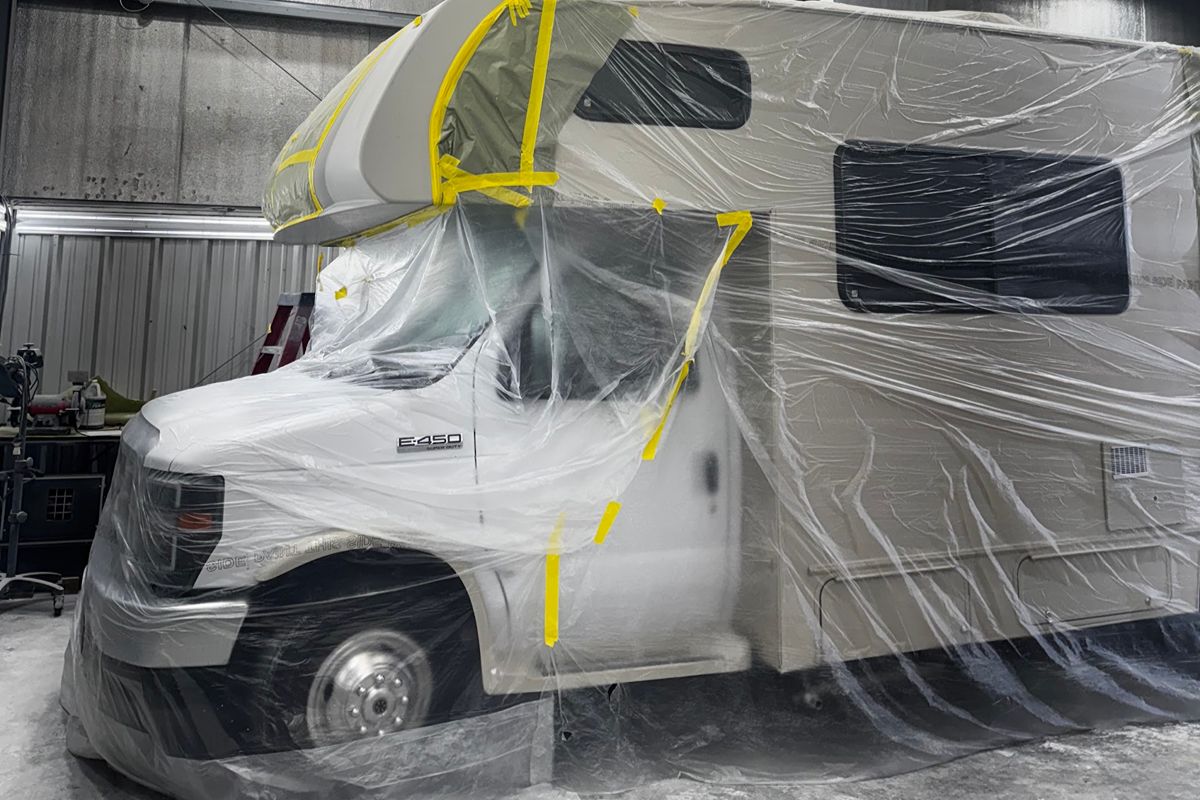
The hailstorm just rolled through, or you misjudged a low clearance, or someone clipped your rig at the campground. Now you are staring at cracked fiberglass and wondering where to take it. For most people, the first instinct is the auto body shop down the street, or the shop your insurance company calls its preferred option.
Here is what is worth knowing before you make that call. An RV is not a big car. It is built more like a boat bolted onto a house frame, and that changes almost everything about how it gets repaired. The materials are different, the finish is different, and the rig is simply too tall and too heavy for most car-focused shops to take in.
This guide walks Denver and Front Range RV owners through what actually separates an RV body shop from an auto body shop. It covers how RVs are built, why gel coat is not automotive paint, why a car shop usually cannot fit a motorhome, which certifications matter, why the bill runs higher, and how your insurance and Colorado weather factor in. This is the explanation we give RV owners every week at FiberglassWorx, the dedicated RV body shop in Denver.
The honest answer is usually no, at least not for the parts that make an RV an RV. A car shop may be able to help with a bolt-on automotive component, but the body, sidewalls, front and rear caps, roof, and structure are a different trade. Plenty of owners only learn this after they have already driven across town and been turned away at the door.
Two things drive that answer. The first is materials. An RV's shell is fiberglass and gel coat bonded over a foam core, framed with aluminum or wood, not the stamped steel of a car. The second is size. A motorhome or fifth wheel is far taller, longer, and heavier than anything built for a standard bay.
None of that is a knock on auto body shops. They do excellent work inside their lane. It just is not the same lane. The rest of this article breaks down why, so you can choose the right shop the first time instead of the second. You can see the full scope of that specialized work on our RV fiberglass repair and restoration page.
A little of each, and almost nothing like a car. A car is a stamped-steel unibody, one welded shell engineered to crumple in a crash. An RV borrows its skin from the boat world, meaning fiberglass and gel coat, and its bones from the building trade, meaning framed and insulated walls. Seeing that mix is the fastest way to understand why the repair is a different job.
Most modern RVs use a sandwich-style wall. A thin exterior fiberglass skin and an interior panel are bonded to a foam core and pressed together. Finished walls are often just three-quarters of an inch to a couple of inches thick, and the outer skin can be as thin as three-hundredths of an inch. Behind that skin sits a substrate like lauan plywood or Azdel composite. It is light, it is strong for its weight, and it behaves nothing like sheet metal when it is damaged.
Where a car has a steel unibody, most RVs are framed with lightweight aluminum tubing or wood. That aluminum framing is thin, often around forty-five thousandths of an inch. It is enough to hold the structure together and take a screw, but too thin for the kind of structural welds a car frame relies on. Repairing it well means understanding how the frame, skin, and core work together, not just how to pull a bent panel.
Not every RV is a laminated box. Some are molded fiberglass shells formed in one piece, like the Escape trailers we carry as an Escape dealer, along with Scamp, Casita, and Oliver. Each type gets repaired a different way, which is why a shop that works across brands has to carry a far wider set of skills than a car shop needs. FiberglassWorx also handles Tiffin, Newmar, Grand Design, Winnebago, Jayco, and more. For the heavier jobs, that means true structural fiberglass repair a general body shop can't do.
The glossy finish on most RVs is not the clear coat you would find on a car. It is gel coat, a fiberglass product, and that one difference changes how a repair gets matched, blended, and finished.
FiberglassWorx finishes repairs in color-matched gel coat as part of its six-step process: inspect, sand, bond, mask, paint, and finish. That blends the fix into the surrounding surface instead of letting it stand out. See how it plays out in our color-matched cosmetic fiberglass repair.
Even when a car shop has the skill for a small fiberglass part, the building itself usually cannot take a motorhome or fifth wheel. It comes down to physical space and equipment.
This is where a dedicated facility earns its keep. FiberglassWorx works out of an indoor shop built for big rigs, with temperature and humidity kept in check so fiberglass and resin cure properly. That control matters a lot in Colorado. You can see our recent RV repair work to get a feel for the scale of the jobs that come through.
Once you accept that an RV is a different animal, vetting a shop gets simpler. Here is the short checklist worth running through before you hand over the keys.
Look for hands-on fiberglass fabrication, gel coat repair, and sidewall, cap, and roof experience, not just car panels. RV bodywork means rebuilding laminated skins and molded parts and blending gel coat by hand. A shop that lives in this world every day will talk fluently about cores, substrates, and bonding, not just dents and paint.
Certifications and training tell you where a shop's expertise actually lives. Car-focused credentials are built around automotive structures and welding, which is not the same as working on fiberglass, gel coat, and RV construction. Look for a shop whose hands-on training and track record clearly match RV bodywork, not just cars.
The building matters as much as the resume. You want an indoor, climate-controlled shop with booths tall and long enough for your rig and lifts rated for its weight. Indoor work also means cleaner prep and a controlled cure, which is exactly what fiberglass and roof coatings need to bond correctly and last through Colorado's swings.
The best RV shops manage the claim, not just the repair. That means documenting damage to adjuster standards, submitting photos, and handling the supplements that come up once a wall or cap is opened. A shop that deals with your adjuster directly keeps you out of the middle and moves the job along faster.
FiberglassWorx checks every box: more than 20 years of combined fiberglass experience, a family-owned crew founded by the Mian brothers, a dedicated indoor facility, direct insurance handling, an Escape Trailer Industries service partnership, and 200-plus five-star Google reviews. Get to know a family-owned RV specialist, or check our reviews and credentials before you decide.
Delamination is a failure mode cars simply do not have. It happens when the bonded layers of a laminated wall start to separate, usually after moisture works its way in, leaving the surface looking puffy, wavy, or bubbled. On a fiberglass RV wall, those layers are supposed to act as one. Once they come apart, the wall loses strength and the damage tends to spread.
Here is why it stumps a standard shop. The real problem is hidden behind the skin, and it is structural, not cosmetic. Skimming body filler over a soft spot hides it rather than solving it, and a genuine fix can mean rebuilding an entire panel. A car-focused shop is not looking for moisture paths, foam-core damage, or a bonding failure, because nothing on a car works that way.
The takeaway is not that every shop should fix delamination. It is that spotting it takes RV-specific eyes. Knowing the difference between a surface blemish and a wall that is quietly failing is exactly the judgment you want from RV fiberglass specialists before any repair begins.
If an adjuster points you toward a preferred shop, know this. In Colorado, you get to choose who repairs your rig. Insurers are not supposed to force you into a particular facility or penalize you for picking one that is not on their list. The choice is yours to make.
That matters for RV owners specifically. A preferred shop is often an auto collision shop that is not equipped for RV work, so steering you there can send your rig somewhere that cannot actually do the job. You are free to choose an RV specialist even when a car shop is the default suggestion.
The practical worry then becomes paperwork, and that is where the right shop earns its keep. FiberglassWorx works directly with adjusters, documents the damage, submits the photos, and handles the supplements that surface once the teardown reveals what is underneath. That is a core part of our RV collision repair with insurance handled.
Sticker shock is common on an RV estimate, and it helps to know it is not markup. It is simply a bigger, more involved job, and we would rather set that expectation honestly up front.
Because a real number depends on what is under the surface, FiberglassWorx gives a free in-person verbal estimate rather than a guess over the phone. A detailed written quote runs 175 dollars, credited back to your invoice when you move ahead. When you are ready, get a free in-person estimate.
Colorado gives RVs a beating that flatland states never see, and a lot of it lands squarely in fiberglass territory. The Front Range sits in the middle of Hail Alley, where the state leads the nation for hail losses and the Denver metro ranks among the costliest places in the country for hail claims. Three or four catastrophic storms roll through in a typical year, and an RV parked outside is a sitting target. Hail-dimpled gel coat and roofs need the exact fiberglass skills a car shop does not carry.
The sun does slower damage. At mile-high elevation the UV is noticeably stronger than at sea level, which oxidizes and chalks gel coat over time, while Colorado's freeze-thaw swings work small cracks into bigger ones. Even mountain driving plays a part. Tall rigs catch overpasses and tunnels, and I-70's Eisenhower Tunnel reroutes anything over height onto the bypass.
This is why an indoor, controlled shop is not a luxury here. It is how repairs and coatings cure correctly against Colorado's conditions. It is also why prevention pays, and many owners add a ceramic coating to slow UV damage before it starts. We handle both the storm damage, through RV hail damage repair, and the prevention, through ceramic coating for UV protection.
The dealership can feel like the obvious place to go, but collision and body work is often not where its service department shines. A few things are worth weighing.
That last point is the whole philosophy: renovation over replacement. When other companies say no, we say yes, and we would rather rebuild what you own than send you to the sales lot. See what that looks like on a real Class A collision rebuild.
It all comes back to one idea: different vehicle, different trade. An RV is fiberglass, gel coat, foam core, and framing on a rig that is too big for a car bay, so the smart move is a shop built for exactly that.
FiberglassWorx is a dedicated indoor fiberglass shop at 7685 Dahlia Street in Commerce City, serving Denver, the Front Range, and owners who drive in from much farther. We handle the insurance, turn most jobs in four to six weeks instead of four to eight months, and back it with 200-plus five-star Google reviews and a better-than-factory standard. The estimate is free and in person, because your rig deserves a real look, not a phone guess.
Tell us what you need and we will handle the rest. Call (303) 585-0515, or get a free estimate to get started.
